
Applications and Use Cases of Frequency-Stabilized He-Ne Lasers
Helium-Neon (He-Ne) lasers possess excellent monochromaticity, coherence, and directivity, making them highly utilized in fields demanding high precision, stability, and beam quality.
| Objective | Application | Utilized Optical Property |
|---|---|---|
| Measure | Length/distance measurement, shape measurement | Coherence |
| Measurement of vibration and velocity displacement | Doppler effect | |
| Inspect | Composition analysis by spectroscopy | Wavelength shift |
| Align & Standardize | Alignment and guide light | Directivity |
| Calibration and quality assurance | Stability |
[Measure] Capturing Dimensions and Motion with Extreme Precision
1. Length/Distance and Shape Measurement (Utilizing Coherence)
Taking advantage of the high coherence of He-Ne lasers, they are used as laser light sources for various interferometers, serving as an “ultra-precision ruler in nanometers.” It is an indispensable light source for determining static dimensions and absolute positions, such as in the shape measurement of smartphone lenses, flatness measurement of semiconductor materials, and ultra-precision stage positioning control in semiconductor lithography equipment.
A typical configuration of an interferometer using a laser as a light source is the “Fizeau Interferometer” (Fig. 1). It creates interference fringes by superimposing the laser light reflected from a reference surface and the surface to be measured (test object). This mechanism allows for high-precision reading of slight unevenness or distortion of the object from the fringe pattern. The highly stable wavelength characteristic of the He-Ne laser is maximized in this measurement.
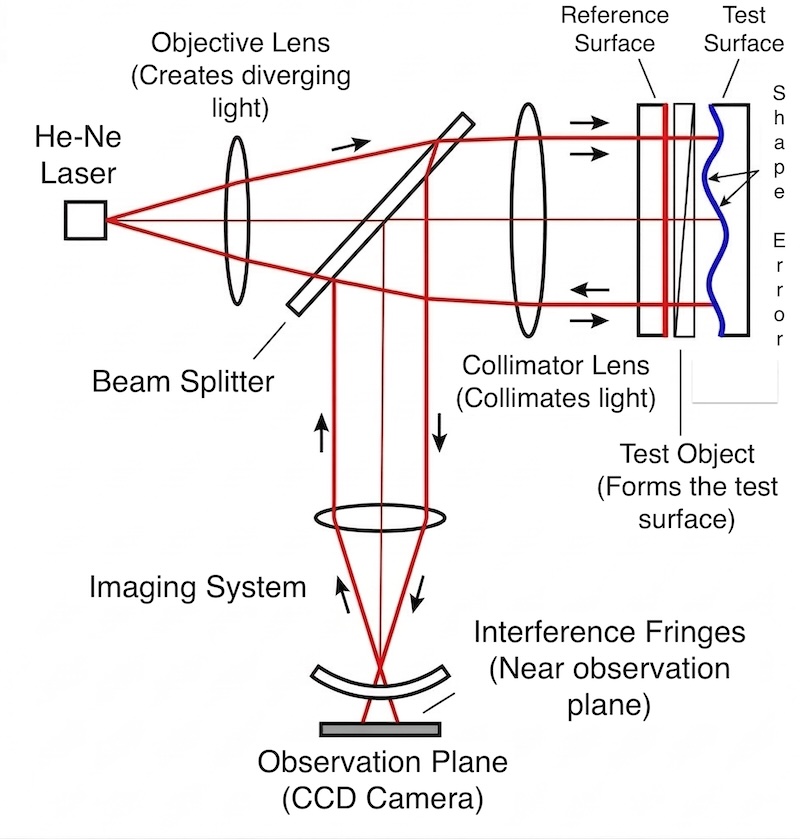
Fig. 1: Configuration and Measurement Principle of the Fizeau Interferometer
2. Vibration and Velocity Displacement Measurement (Utilizing the Doppler Effect)
It highly sensitively detects slight frequency changes (Doppler effect) when laser light hits a moving object and returns. As a light source for a Laser Doppler Vibrometer (LDV), it acts like a “radar gun,” analyzing dynamic movements and velocities of objects in real-time without contact, such as the runout of a rotating body or the vibration of a speaker.
In a typical applied device, the Laser Doppler Vibrometer (LDV), the internal laser light is split into a “measurement beam” and a “reference beam.” The measurement beam reflected from the moving object is superimposed and interfered with the reference beam (Fig. 2). To accurately calculate velocity and displacement from the minute frequency shift (Doppler shift) that occurs at this time, it is absolutely essential that the frequency of the reference light source (He-Ne laser) is extremely stable.
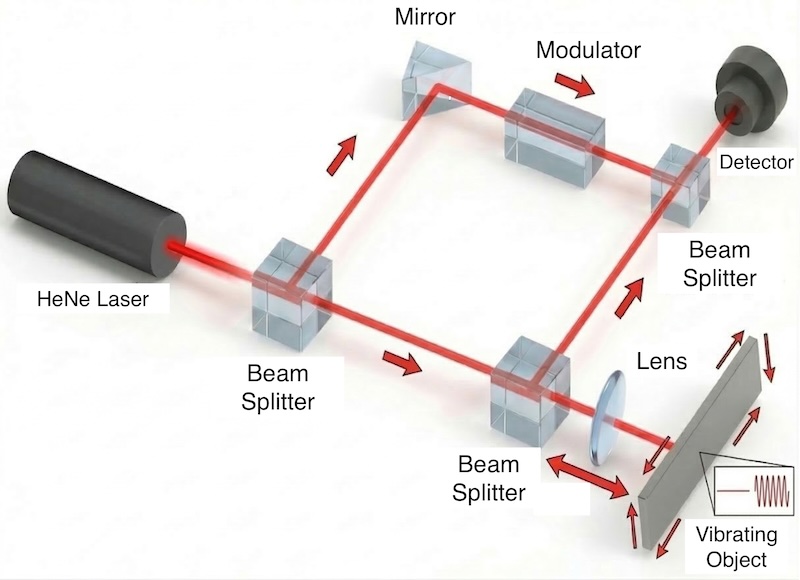
Fig. 2: Configuration and Measurement Principle of the Laser Doppler Vibrometer (LDV)
[Inspect] Examining Material Composition and Invisible Internal States
3. Composition Analysis by Spectroscopy and Internal Stress Inspection
It is used as a light source for Raman spectroscopy, which identifies molecular structures from the wavelength change of scattered light after irradiating a material with a laser. It also plays an active role in “birefringence measurement,” which detects “invisible distortion (stress)” hidden inside transparent glass substrates or functional films as a phase difference of light. Through this, it functions as an “appraisal light” to prevent performance degradation and defects in products and materials.
In “Raman spectroscopy,” a typical method for composition analysis, a sample is irradiated with laser light, and the extremely weak scattered light (Raman scattered light) generated is detected by a spectrometer to obtain a spectrum (Fig. 3). Because the molecular structure and state of the substance are identified from the peak positions of the obtained spectrum, the He-Ne laser—which has low noise and a single, non-fluctuating wavelength (frequency)—is highly valued as a high-precision excitation light source.
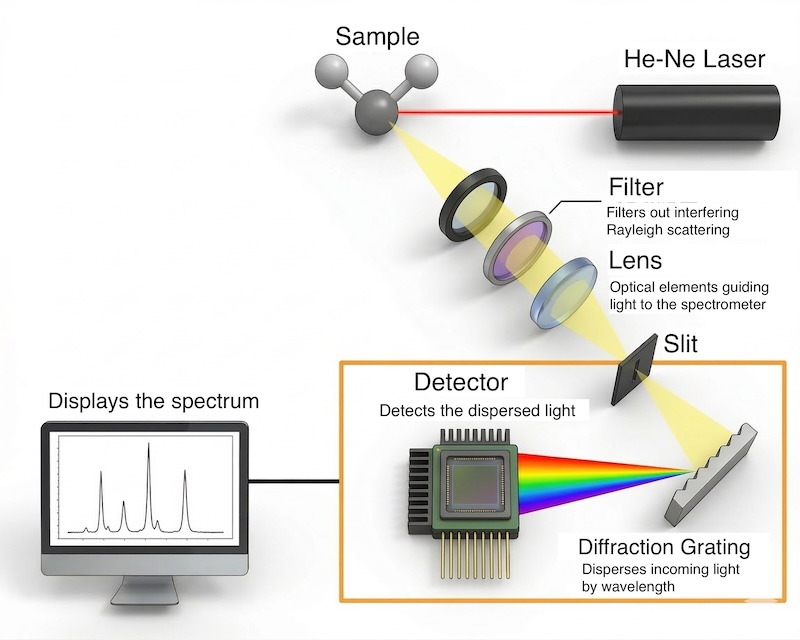
Fig. 3: Mechanism of Raman Spectroscopy
[Align & Standardize] Serving as the Ultimate Reference and Guiding to the Correct Position
4. Alignment and Guide Light (Utilizing Directivity)
Taking advantage of the property that light travels straight without spreading (directivity), it functions as a “straight optical ruler” that never bends. It provides reliable guidelines on-site where centering of machine tools and precise alignment are required. Furthermore, by utilizing this directivity, its application to next-generation technologies such as long-distance wireless optical transmission is also being considered.
5. Calibration and Quality Assurance (Utilizing Stability)
Utilizing the greatest strength of the frequency-stabilized He-Ne laser—its “extremely stable oscillation wavelength”—it functions as an “absolute standard” to judge whether other equipment is operating correctly. It plays the role of a master (primary standard) for precision inspection (calibration) of machine tools and as a national standard-class calibration light source for measuring instrument manufacturers.