

- Product nameLAK-Pinset01
- ModelLAK-Pinset01
- PriceUS$4,480 (EXW Osaka)
- Lead time1 week – 2 months
Optical tweezers are a technology and device that use the radiation pressure of laser light to capture (trap) and manipulate small objects such as cells.
Because laser light can be used to grasp and move objects in a manner similar to a pair of tweezers, this technique is referred to as optical tweezers, optical traps, or laser tweezers.
Because laser light can be used to grasp and move objects in a manner similar to a pair of tweezers, this technique is referred to as optical tweezers, optical traps, or laser tweezers.
The Optical Tweezers Kit includes a complete set of components: a laser irradiation system, a laser focusing optical system, and an observation optical system for the target material. By assembling these components from scratch, users can easily learn the fundamentals of optical tweezers.
*Optical tweezers were awarded the Nobel Prize in Physics in 2018.*This product was developed under the supervision of Professor Hitoki Yoneda as part of the “Optical Tweezers Program,” which is used in the hands-on laser education program at the Laser Science Center for Next Generation, The University of Electro-Communications.

Feature
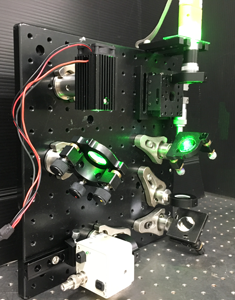
- Simple configuration
- Customizable
- Green laser optical tweezers
- Low price
Comparison with other companies’ products
| This product | Conventional products | |
|---|---|---|
| Customizable | ◎ | ー |
| Laser Wavelength | 0.5 μm | 1 μm |
| Laser Output | 200 mW | ー |
| Automatic Moving Stage | ☓ | ◯ |
| Assembly by High School Students | ◯ | ー |
| Price | US$4,480 (EXW Osaka) | Over US$16,090 |
Purpose
- Trapping of 1 μm fat globules undergoing Brownian motion in water
- Trapping nanometer to micrometer-sized particles
- Non-destructive trapping of viruses, bacteria, enzymes and proteins
Composition
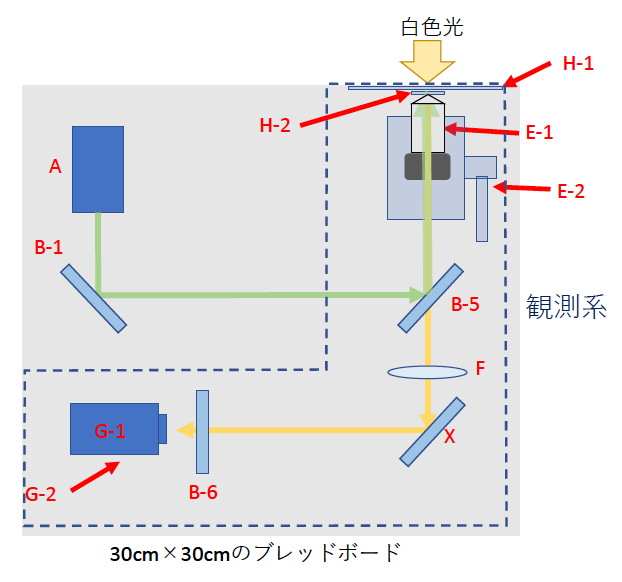
Click to enlarge
This kit includes the following:
- A:Laser module
- B:532 nm HR mirror
- E:Objective lens and its stage
- F:Plano-convex lens
- G:CCD camera and its stage
- X:Broadband mirror
For measuring samples
- Glass slide (H-1) and cover glass (H-2)
- Sample: Whipped cream (spherical, approximately 1 μm to 10 μm)
Other accessories
- Breadboard (300 mm x 300 mm)
- Display (for CCD camera)
- Flashlight (light source for observation)
Options (paid)
Optical tweezers kit assembly video
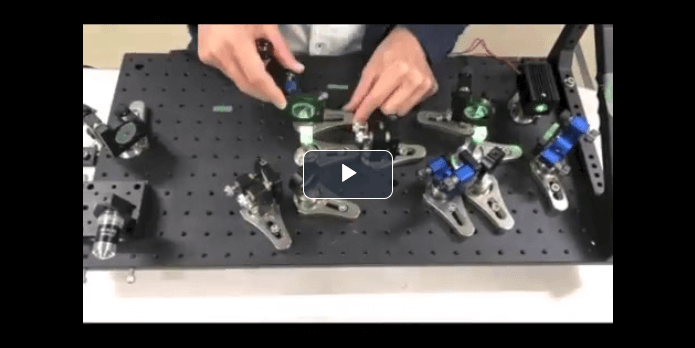
The video on assembling the optical tweezers kit is available as a paid video on OptiVideo.
Optical Tweezers Kit Video
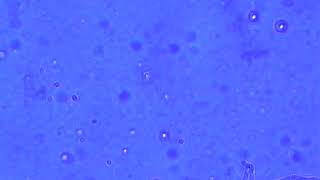
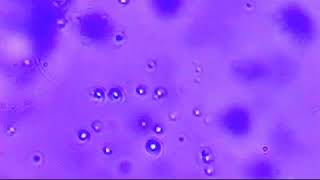
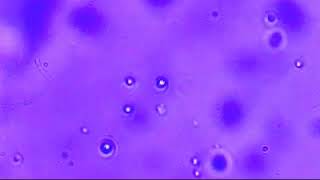
Optical tweezers in action
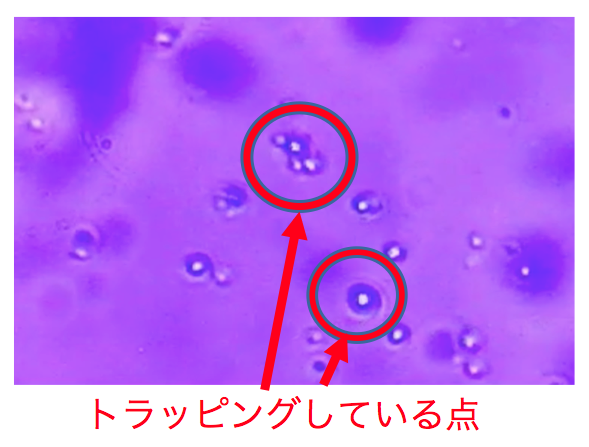
Click to enlarge
When using one beam
Customizing to 4 beams – 1
Customizing to 4 beams – 2
FAQ
Is it applicable to particles on solid surfaces?
If the solid is in a gas environment, the solid and the particles are held together by van der Waals forces, which are quite strong (the same reason why it’s difficult to remove dust from a mirror surface with an air duster), so it would be difficult to capture the particles with optical tweezers and pull them off the solid (lifting them into the gas). I think it would be possible to move them on the solid surface by applying pressure with a laser. If you mean a solid and particles in a liquid, like the situation between glass and the fat in coffee milk, then it would be possible. If you could explain the specific situation, I’m sure I could answer in more detail, so please don’t hesitate to ask.
If the solid is in a gas environment, the solid and the particles are held together by van der Waals forces, which are quite strong (the same reason why it’s difficult to remove dust from a mirror surface with an air duster), so it would be difficult to capture the particles with optical tweezers and pull them off the solid (lifting them into the gas). I think it would be possible to move them on the solid surface by applying pressure with a laser. If you mean a solid and particles in a liquid, like the situation between glass and the fat in coffee milk, then it would be possible. If you could explain the specific situation, I’m sure I could answer in more detail, so please don’t hesitate to ask.
Is it not applicable if the target is opaque?
The easiest way to do this is to change the wavelength of the laser to one that is transparent to the target. If wavelength selection is not possible, the laser will only generate a pushing force on the target, so in that case it is thought that it can be moved by pinching the target by pushing with the laser from both the left and right. In fact, this pinching style was what Dr. Ashkin, who proposed optical tweezers, initially proposed. However, since the target will easily escape up and down if you only push it from the left and right, it is necessary to hold it down with lasers from above and below as well. This seems difficult with the current setup.
The easiest way to do this is to change the wavelength of the laser to one that is transparent to the target. If wavelength selection is not possible, the laser will only generate a pushing force on the target, so in that case it is thought that it can be moved by pinching the target by pushing with the laser from both the left and right. In fact, this pinching style was what Dr. Ashkin, who proposed optical tweezers, initially proposed. However, since the target will easily escape up and down if you only push it from the left and right, it is necessary to hold it down with lasers from above and below as well. This seems difficult with the current setup.
What is the maximum micron size that can be applied?
It depends on the laser power and the weight of the target. Simply put, a 10 mW laser will trap 10 um, and a 100 mW laser will trap about 100 um. However, if you want to trap something 100 um, you will need to use an objective lens with a longer focal length than you currently have and slowly narrow it down toward the target. The observation system also needs to change lenses if you want to observe something 100 um.
It depends on the laser power and the weight of the target. Simply put, a 10 mW laser will trap 10 um, and a 100 mW laser will trap about 100 um. However, if you want to trap something 100 um, you will need to use an objective lens with a longer focal length than you currently have and slowly narrow it down toward the target. The observation system also needs to change lenses if you want to observe something 100 um.
It may depend on the size, but how many dynes of force can be generated?
A 10 mW laser exerts a force of about pN (piconewtons), or 10^-5 dyne. At 100 mW it’s 10^-4 dyne.
A reference PDF file is provided below. On page 2, v=100 μm/s is the approximate speed at which a particle can be moved while remaining trapped when using a 10 mW laser.Reference PDF
A 10 mW laser exerts a force of about pN (piconewtons), or 10^-5 dyne. At 100 mW it’s 10^-4 dyne.
A reference PDF file is provided below. On page 2, v=100 μm/s is the approximate speed at which a particle can be moved while remaining trapped when using a 10 mW laser.
Regarding the LAK-Pinset01 optical tweezers kit, what types of microscopes are compatible with it? Also, I think a high-magnification objective lens is required, so does the kit include anything to focus the laser like an objective lens?
The optical tweezers kit comes with a CCD camera that can be connected to a PC for observation. A 60x microscope lens is also included.
The optical tweezers kit comes with a CCD camera that can be connected to a PC for observation. A 60x microscope lens is also included.
When watching the video, it seems like the laser focus is moving slightly, but is this due to a mirror or something moving along the optical path? Also, does this include the stage?
Yes, the particles are moved by moving the mirror. The trapped particles can be moved by shifting the position of the laser with the mirror (B-5 in the diagram). This is exactly what optical tweezers are. The objective lens and CCD camera are equipped with a stage for adjusting the focal position.
Yes, the particles are moved by moving the mirror. The trapped particles can be moved by shifting the position of the laser with the mirror (B-5 in the diagram). This is exactly what optical tweezers are. The objective lens and CCD camera are equipped with a stage for adjusting the focal position.
Product Sales History
(Updated August 2025)
Academic
- Japan Atomic Energy Agency
- Chitose Institute of Science and Technology
- Tokyo University of Science (formerly Tokyo Institute of Technology)
- Kindai University
- Kyoto University